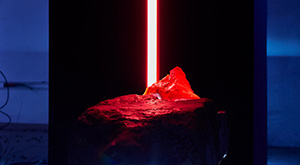
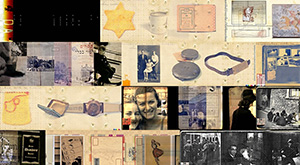
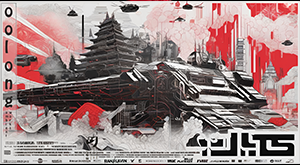
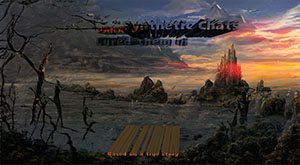
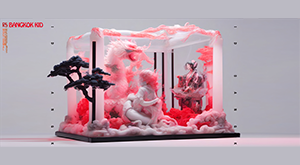
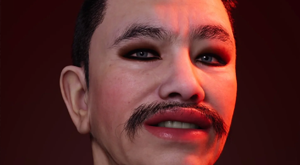
Paradise Now is an umbrella title for a body of works exploring the convergence of AI-generated imagery, animation, and text.
Paradise Now (Volume 2) unfolds as a silent ritual: a technological apparition in which residual science-fiction imagery collides with ancient theological structures. The work stages a tension between futurity and belief, simulation and faith, without resolving their friction.
The title carries a deliberate ambivalence. It invokes Apocalypse Now as a distant, cynical echo, while exposing the unresolved longing embedded in the phrase itself. Paradise appears not as a promise, but as a condition endlessly deferred—simulated, rehearsed, never arrived at.
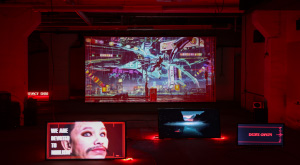
The installation operates through two simultaneous projection systems.
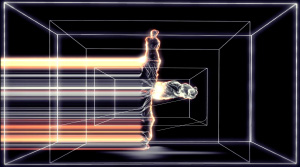
At the front, a holographic LED screen presents a small human figure, draped in fabric, moving in a restrained, trance-like choreography. The gestures oscillate between a displaced, itinerant figure associated with speculative futures and a pre-modern wanderer drawn from Jewish and Christian iconography. Time collapses: the image resists historical placement, hovering between antiquity and projection.
The figure—named Novery1 (a fusion of “no one” and “everyone”)—functions as an abstract consciousness avatar of the artist, suspended in a zone of meta-time. Rather than performing character or narrative, Novery1 operates as a vessel for distributed identity, testing the unstable boundary between the embodied and the synthetic, the natural and the supernatural.
Behind it, a circular rear projection continuously generates shifting landscapes. These environments never settle, emphasizing impermanence, mutation, and disorientation. The source material originates from scans of coffee stains collected from an espresso machine—accidental, everyday residues translated into raw visual data. Through AI-based processing, these organic traces evolve into fluid, endlessly morphing sequences, suggesting matter caught in perpetual transition, neither fully material nor fully virtual.
March 30 – November 28, 2024, MUZA. Curator: Raz Samira