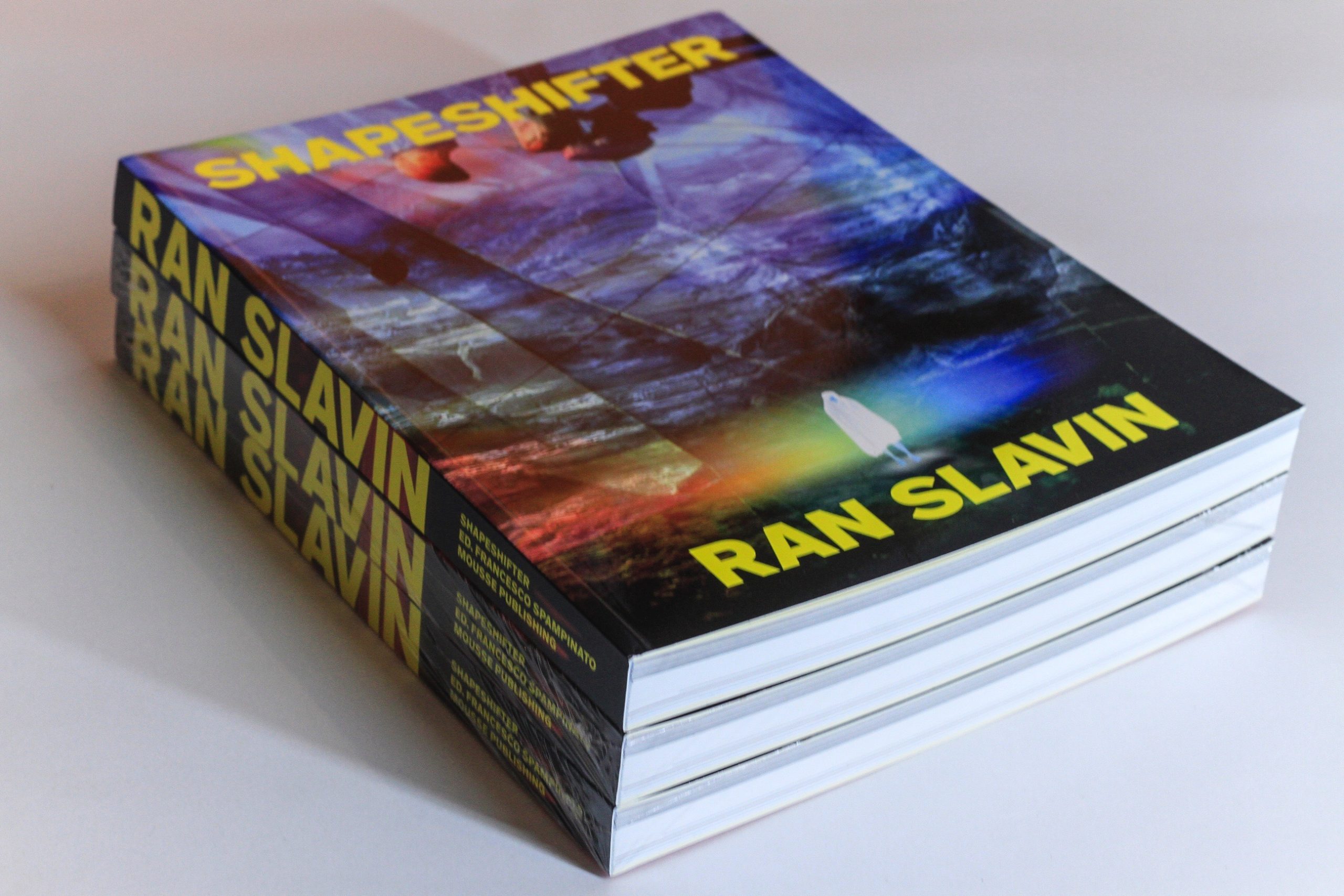
Ran Slavin is an artist and filmmaker working between cinema, sound, and installation. His works construct environments rather than images: spaces in which architecture, narrative, and technology reorganize how the viewer perceives time and attention.
Across moving image installations, experimental films, and electronic music, Slavin treats media as behavioral systems. The seated cinema spectator, the wandering museum visitor, and the listening body become different viewing positions within the same artistic field. Sound functions as spatial structure, images operate as environments, and stories unfold as psychological atmospheres rather than linear plots.
Although largely self-taught as a musician and filmmaker, Slavin studied at the Bezalel Academy of Arts and Design (BFA). His work has been exhibited internationally at venues and biennales including the Venice Biennale, the Istanbul Biennial, Transmediale, the Nakanojo Biennale, the Mediations Biennale, the Wrong Biennale and the Ars Electronica Festival, among others. His works have also appeared in public media displays including screenings at the New Museum and large-scale digital billboards in Times Square and Hong Kong. His films have screened at international festivals including the Torino Film Festival, the Shanghai International Film Festival, the Tallinn Black Nights Film Festival, and Camerimage
His films and artworks have received numerous awards, including Best Feature Film for Call for Dreams (Utopia Festival, La Paz Film Festival, AVIFF Cannes), an Honorary Mention at Ars Electronica, and grants from the Rabinovich Foundation, Mifal HaPais Council for Culture and Art, and the New Fund for Cinema and Television.
Alongside his visual practice Slavin has developed an extensive body of electronic music that expands the spatial logic of his installations into sound. Emerging in the early 2000s as one of the pioneers of underground experimental electronica in Tel Aviv, his work engaged with the aesthetics of digital error, micro-rhythms, and fractured sonic textures at a moment when the genre was redefining electronic composition.
His music was featured on the influential Clicks & Cuts series released by Mille Plateaux, a landmark compilation that helped shape the global glitch movement. Over time, this foundation in glitch and noise evolved toward the territories of IDM and deconstructed club music — interrogating the structural logic of rhythm itself, dismantling the dancefloor impulse into something more unstable, cerebral, and spatially disorienting. Slavin’s recordings move between ambient structures, fractured electronics, and cinematic sonic landscapes, treating rhythm and texture as architectural elements. His music is currently releasing through his own imprint Nocturnal Rainbow Recordings alongside earlier releases on Sub Rosa, Mille Plateaux, and Crónica among others.

Contact:
ranslavin (@) gmail.com