Media: video and sound
Format: DCP, Pro Res QT. projection. 3840×1080 pixel. color 25p
Year: 2022
Duration: 23:52 minutes
Languages: Hebrew and English
Subtitles: Hebrew and English
Shot mostly in Greece, and Tokyo
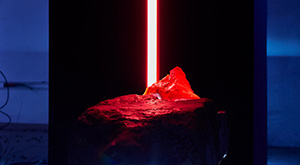
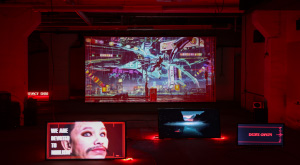
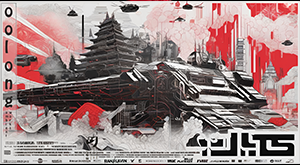
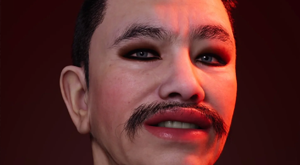
4 Dreams unfolds in four acts—four dream-states—each structured as a nocturnal, abstract narrative. At the center of these dreams lies a meditation on time, presence, beauty, and the acceptance of an omnipresent mystery. The work is intermittently narrated by a child we never see: a voice attempting to enter, absorb, and decipher the subtle essences woven into reality.
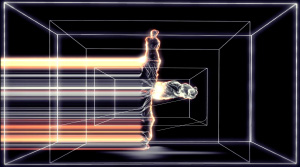
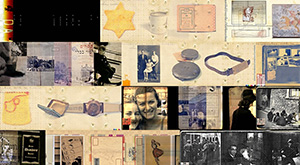
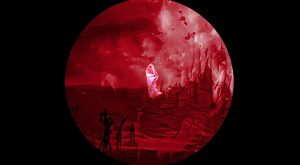
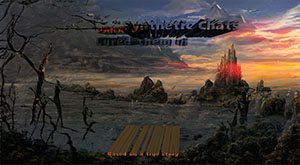
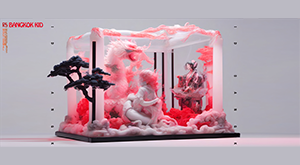
4 Dreams is a visual-acoustic travel journal—chaotic, immersive—charting the liberation of consciousness from the residue of its own illusions. It operates as a collage of images and sounds that mirror inner territories of dreaming, fantasy, devastation, mourning, dread, and desire. Within its surreal, meta-real aesthetic emerge neglected spaces: fragmented landscapes, abandoned parks, empty playgrounds.
Water recurs as a simultaneous presence and passage—abandoned waterslides, a hand submerged, a ship in a storm, a sinking sun.
This intermediate consciousness expresses a desire for awakening from the dream, echoing the child’s quiet question: Have you ever missed something you’ve never had? Perhaps it recalls a state of wakefulness, or seeks entry into another mode of knowing:
And the wind moves thoughts.
Deep under the water
Someone once told me
About another dimension of consciousness.
The relentless flow of images induces a falling sensation akin to deep dreaming—the REM state, marked by rapid, uneven breath. In this sense, 4 Dreams resonates with the concept of the Bardo described in The Tibetan Book of Living and Dying: an intermediate state between life, death, and rebirth, where perception detaches from fixed identity.
The child’s voice articulates a longing for unmediated knowledge:
Witness the inherent chaos.
Witness the inherent order.
Among the many approaches to dreaming, 4 Dreams aligns with the view that dreams are not symbols to be decoded but realities in themselves—raw experiential matter acting directly upon the unconscious. As Susan Sontag wrote, “Our task is not to find the maximum amount of content in a work of art… Our task is to cut back content so that we can see the thing at all.”
The work seeks to generate new modes of sensory perception—beyond language—liberating desire from cultural and rational frameworks. Here, the artist adopts the position of the child: attempting to exit the self in order to encounter what lies beyond it, a knowledge both liberating and terrifying. Through and beyond the movement of the camera, a space of continuous present emerges.
Time is not straight, says the child.
Any attempt to force the images into linear narrative or linguistic coherence produces collapse. Meaning fragments. Interpretation is asked to pause. The resulting gap in consciousness is not failure but surrender.
Slavin’s world is populated by images that refuse resemblance. No object in reality corresponds directly to what is seen. His visual language operates beneath or beyond the threshold of comprehension, oriented toward nothingness, silence, and the dissolution of psychic structure. It is a yearning to unload the self, to let exterior reality rupture, and to see—through the child’s voice—the miracle of beauty in all things. (Excerpt of text by Adiya Porat)